This is default featured slide 1 title

Go to Blogger edit html and find these sentences.Now replace these sentences with your own descriptions.This theme is Bloggerized by Lasantha Bandara - Premiumbloggertemplates.com.

This is default featured slide 2 title

Go to Blogger edit html and find these sentences.Now replace these sentences with your own descriptions.This theme is Bloggerized by Lasantha Bandara - Premiumbloggertemplates.com.

This is default featured slide 3 title

Go to Blogger edit html and find these sentences.Now replace these sentences with your own descriptions.This theme is Bloggerized by Lasantha Bandara - Premiumbloggertemplates.com.

This is default featured slide 4 title

Go to Blogger edit html and find these sentences.Now replace these sentences with your own descriptions.This theme is Bloggerized by Lasantha Bandara - Premiumbloggertemplates.com.

This is default featured slide 5 title

Go to Blogger edit html and find these sentences.Now replace these sentences with your own descriptions.This theme is Bloggerized by Lasantha Bandara - Premiumbloggertemplates.com.

About Us

Tuesday, March 13, 2007

Translating the Gospel, By Mike Frost

Here is the link to an article by Mike Frost called Translating the Gospel. It is about contextualizing the Bible to where people are preaching it, and its importance. It unfortunately only gives examples at the end as to how it was done IN the Bible as opposed to how to do it today. I suspect if you were to buy the book mentioned in the article you would be given some ideas. For now I'm only posting the link, and have sought permission to post the article itself and am waiting for a reply. Enjoy!

http://www.cegm.org.au/resources/translating%20the%20gospel.htm

This is a debate in New York as to whether or not America is too damn religious. If you have an hour an a half to kill, and a computer with you, listen to the whole thing, or you can download the mp3 edited version which is significantly shorter.
Enjoy!

http://www.npr.org/templates/story/story.php?storyId=7422542


NPR.org, February 16, 2007 · As if it weren't provocative enough to hold a debate on religion in America, panelists in a recent debate were tasked with answering the following: "Is America Too Damn Religious?"

The event was part of a series of Oxford-style debates called Intelligence Squared U.S. Produced in New York City by WNYC, it is based on the Intelligence Squared program that began in London in 2002. Three experts argue in favor of the motion; three others argue against it.

In a vote before the debate, about 67 percent of the audience agreed with the motion. After hearing the debate, more than 70 percent agreed with the motion, roughly 24 percent were opposed and about 5 percent were undecided, concluding that America is in fact "too damn religious."

Highlights from the debate:

FOR THE MOTION

Barry Lynn
Photo: Kevin Wick/Longview Photography

The Rev. Barry Lynn, executive director of Americans United for Separation of Church and State, says: "What is a damned religion? Damned religion is a religion so weak-willed and unsure of its own capacity to persuade others to support it or live by its guidance that it seeks the blessing of government. That it seeks financial aid from government. And that it even tries to convert its theological beliefs into legislative fiats. This damned form of religion is a corruption both of faith and of constitutional democracy. And it makes a mockery of the best in our history...."


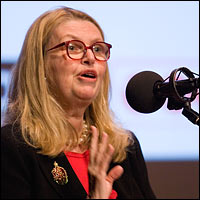
Susan Jacoby
Photo: Kevin Wick/Longview Photography

Susan Jacoby, author of Freethinkers: A History of American Secularism: "We must first talk about the retrograde form of religion that holds one-third of Americans in thrall. This is the proportion of Americans who say that they believe every word in the Bible is literally true. Not merely inspired by God but the literal handwriting of God. One out of three. What an astounding statistic.... Our opponents would have you believe that those of us who consider America too bloody religious are concerned mainly with legalistic issues involving the separation of church and state. In fact, our nation's excessive religiosity affects individual lives and public policy in ways that are often matters of life and death...."


Alan Wolfe
Photo: Kevin Wick/Longview Photography

Alan Wolfe, director of the Boisi Center for Religion and American Public Life at Boston College: "If Americans were much more religious, there would have been much more protest against the revelations of torture at Abu Ghraib and other aspects of our foreign policy. For someone to be tortured and hung up like he was being crucifixed would be so unacceptable if Americans were more religious that there would have been massive protests. Not only against the tactics, the illegal torture tactics used by the Bush administration, but by the whole war in Iraq, which would have violated the social teachings of the single-most, largest Christian denomination in the United States, the Catholic Church...."


AGAINST THE MOTION

Jean Elshtain
Photo: Kevin Wick/Longview Photography

Jean Bethke Elshtain, a professor of social and political ethics at the University of Chicago: "One should not, from any direction, separate America's citizens who accept a secular world from those, the religious, who alleged do not. Citizens of religious commitment are among the most enthusiastic supporters of a secular government. They don't want established religion, but they also understand that to support a secular government and state does not commit us to a thoroughly secularized society, shorn of religious voices, symbols, activities and commitments. We would be a greatly impoverished country were this to come to pass. So too damned religious? Nope. Just pretty damned American...."


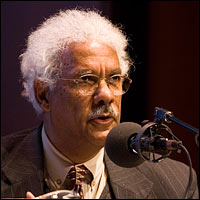
Albert Raboteau
Photo: Kevin Wick/Longview Photography

Albert Raboteau, who teaches religion at Princeton University: "The way in which I took the question — and this partly gets at the question of what is religion — was, what's the role of religion in terms of the American ethos, the spirit of the American people? As we all know, Jefferson changed Locke's notion of the inalienable rights from life, liberty and property, to life, liberty and the... pursuit of happiness. What I see as being part of the ethos of American culture and the American direction has been a reversal of that, those inalienable rights. That is, we are back to life, liberty and the pursuit of property. Property in terms of rampant consumerism, which is what I see as the real danger to American culture and spirit today...."


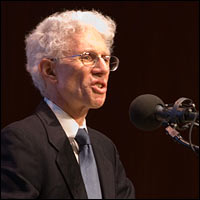
William Galston
Photo: Kevin Wick/Longview Photography

William Galston, a senior fellow at the Brookings Institution: "Religious Americans are among our most engaged citizens today and their engagement strengthens our community.... Religious Americans, unlike what you have heard from our worthy opponents are not — repeat not — a threat to our liberties. An overwhelming majority of religious Americans practice what one eminent scholar has termed a quiet faith. It is private rather than public. Tolerant and inclusive, moderate rather than extreme and above all, non-judgmental."

Thursday, December 07, 2006

Faith and Certainty

Thus everything is assumed to be in order with regard to the Holy Scriptures--what then? has the person who did not believe come a single stop closer to faith? No, not a single step. Faith does not result from straightforward scholarly deliberation, nor does it come directly; on the contrary, in this objectivity one loses that infinite, personal, impassioned interstedness, which is the condition of faith, the ubique et nusquam [everywhere and nowhere] in which faith can come into existence.
Has the person who did believe gained anything with regard to the power and strength of faith? No, not in the least; in this prolix knowledge, in this certainty that lurks at faith's door and craves for it, he is rather in such a precarious position that much effort, much fear and trembling will indeed be needed lest he fall into temptation and confuse knowledge with faith. Where as up to now faith has had a beneficial taskmaster in uncertainty, it would have its worst enemy in this certainty. This is, if passion is taken away, faith no longer exists, and certainty and passion do not hitch up as a team.

Soren Kierkegaard,
Concluding Unscientific Postscript to Philosophical Fragments

Monday, September 25, 2006

Regensburg, Islam, and the Church's response

This is from a Forum post I did at http://3dff.com/php/index.php?sid=1547ea0a104af78324e85d9b84540fc8

From now on if I want to post something on here from there or anywhere else I will most likely just link to it. But for now here you are with it in its entirty except for the intro for the forum specificly.


I first and formost wish to discuss the popes address to the University of Regensburg. I looked all over for the transcript and interestingly enough I found it in english, on a Lebenese website. I have the website below, and the transcript itself in italics just incase they eventually take it down because I have found that links tend to die, and information desired can not be attained because of this.

Your Eminences, Your Magnificences, Your Excellencies, Distinguished Ladies and Gentlemen,

It is a moving experience for me to be back again in the university and to be able once again to give a lecture at this podium. I think back to those years when, after a pleasant period at the Freisinger Hochschule, I began teaching at the University of Bonn. That was in 1959, in the days of the old university made up of ordinary professors. The various chairs had neither assistants nor secretaries, but in recompense there was much direct contact with students and in particular among the professors themselves. We would meet before and after lessons in the rooms of the teaching staff. There was a lively exchange with historians, philosophers, philologists and, naturally, between the two theological faculties. Once a semester there was a dies academicus, when professors from every faculty appeared before the students of the entire university, making possible a genuine experience of universitas - something that you too, Magnificent Rector, just mentioned - the experience, in other words, of the fact that despite our specializations which at times make it difficult to communicate with each other, we made up a whole, working in everything on the basis of a single rationality with its various aspects and sharing responsibility for the right use of reason - this reality became a lived experience. The university was also very proud of its two theological faculties. It was clear that, by inquiring about the reasonableness of faith, they too carried out a work which is necessarily part of the "whole" of the universitas scientiarum, even if not everyone could share the faith which theologians seek to correlate with reason as a whole. This profound sense of coherence within the universe of reason was not troubled, even when it was once reported that a colleague had said there was something odd about our university: it had two faculties devoted to something that did not exist: God. That even in the face of such radical scepticism it is still necessary and reasonable to raise the question of God through the use of reason, and to do so in the context of the tradition of the Christian faith: this, within the university as a whole, was accepted without question.

I was reminded of all this recently, when I read the edition by Professor Theodore Khoury (Münster) of part of the dialogue carried on - perhaps in 1391 in the winter barracks near Ankara - by the erudite Byzantine emperor Manuel II Paleologus and an educated Persian on the subject of Christianity and Islam, and the truth of both. It was presumably the emperor himself who set down this dialogue, during the siege of Constantinople between 1394 and 1402; and this would explain why his arguments are given in greater detail than those of his Persian interlocutor. The dialogue ranges widely over the structures of faith contained in the Bible and in the Qur'an, and deals especially with the image of God and of man, while necessarily returning repeatedly to the relationship between - as they were called - three "Laws" or "rules of life": the Old Testament, the New Testament and the Qur'an. It is not my intention to discuss this question in the present lecture; here I would like to discuss only one point - itself rather marginal to the dialogue as a whole - which, in the context of the issue of "faith and reason", I found interesting and which can serve as the starting-point for my reflections on this issue.

In the seventh conversation (*4V8,>4H - controversy) edited by Professor Khoury, the emperor touches on the theme of the holy war. The emperor must have known that surah 2, 256 reads: "There is no compulsion in religion". According to the experts, this is one of the suras of the early period, when Mohammed was still powerless and under threat. But naturally the emperor also knew the instructions, developed later and recorded in the Qur'an, concerning holy war. Without descending to details, such as the difference in treatment accorded to those who have the "Book" and the "infidels", he addresses his interlocutor with a startling brusqueness on the central question about the relationship between religion and violence in general, saying: "Show me just what Mohammed brought that was new, and there you will find things only evil and inhuman, such as his command to spread by the sword the faith he preached". The emperor, after having expressed himself so forcefully, goes on to explain in detail the reasons why spreading the faith through violence is something unreasonable. Violence is incompatible with the nature of God and the nature of the soul. "God", he says, "is not pleased by blood - and not acting reasonably (F×<>

First and formost the Pope's message was about Faith and Reason, and for the requirement of reason to be apart of faith. The quote that has had certain portions of the Islamic world in an uproar was taken from an EMPEROR in his discussion with a persian intillectual on that very subject. Not only that, but it was written down during a siege that the Emperor was withstanding on the city of Constantinople. Reasonably as a people that all share one religion try and take over and destroy your city are you going to have nice pretty words to describe them much less their faith's founder? I think not. That is just something to mull over in regards to Mr. Paleologus's situation and thoughts at the time of transcription. What the pope said has been taken out of context by those who reacted with violence just as much as those in the west that have agreed with the statement. Both are ignorant reactions and both should be conemend, and are condemend by reason. In fact his point is highlighted, and unfortunatley proved by both reactions. His point being that we as as society must,


". . . [broaden] our concept of reason and its application. While we rejoice in the new possibilities open to humanity, we also see the dangers arising from these possibilities and we must ask ourselves how we can overcome them. We will succeed in doing so only if reason and faith come together in a new way, if we overcome the self-imposed limitation of reason to the empirically verifiable, and if we once more disclose its vast horizons."

If one goes back to the Sweedish cartoon that caused turmoil, we see the same reaction. I will not go on to speak of that, but I bring it up to show that this is a pattern, and will be unless what the Pope wants is attained and what Kester wrote in his blog quoted here http://3dff.com/php/viewtopic.php?t=2848&sid=14b6a76e1014107690d57ba7ba5fb749
that, ". . . more than ever that leadership needs to be round the table."

But what has brought us to this point? How have we been brought to this terrible place? Is it really what some leaders have stated that they "hate" our freedoms, and everything that "democracy" stands for? Is it a clash of cultures or as some have also said another "crusade"?

What I think we are seeing is a backlash two hundred years in the making. That is, as the west rose to power in quite a dramatic and quick fashion the Middle East, and with that the Islamic people were left at a stand still a the hands of this progress. Then due to this Nationalism arose within Islamic countries. After the fall of the Ottoman Empire, and the partitioning of the Middle East after WWI, a sense of bitterness towards the west appeared, and the Arabs who were also Muslims felt they were not ruling themselves and this because of their nationalism is what they wanted. I am esscentially in this last paragraph summing up a few chapters from a book on the iddle east by Arthur Godlshmidt Jr. called A Concise History of the Middle East. It is a good fairly easy read on Islam and the middle east from just before Mohammad, to the Gulf War I in Iraq. I advise anyone that wants a better idea of Islam in history to read this book.

The other part of this dissent in Islam I don' even think can be placed on the shoulders of the West, and it is more accuratley the west getting in the way. This dissent is best seen in Iraq today. Shia and Sunni muslims waring it out for Baghdad. The issue here I think is best explained by an Iranian-American named Reza Aslan in his book No God but God the origins, Evolution, and Future of Islam.Here he makes the point that in his eyes Islam is going through a reformation of their own as Christianity did. This being between moderate Muslims and the more violent and hardline "extremist" Muslim factions. You can find his website here http://www.rezaaslan.com/ where there is info about him, and links to interviews with him including him on the Daily show with Jon Stewart.

So, what do we do? Firstly it is evident that at least to a point Chrstianity and America are in some Middle Eastern minds synonymous. It is important to make it clear that an American does not a Christian make. Nor does a Christian an American make. Kierkegaard was it who reminded us that a nation can not be "Christian" because there are multitudes who proclaim a relgion that do not practice a faith. It was also John who said in his letter that God is love and if you do not love others you do not know God. Thus if Christians do not love others, they do not know God. It is evident that there are many people that go to local congregations and proclaim the "religion" of Christianity that do not in their actions, in who they are, proclaim their relationship with God. That is not new. Unfortunatley also, there are high profile men that merely proclaim the "religion" of Christianity, and state terrible things that I truely belive break God's heart. This unfortunatley is another part of what the outside wordl sees and even more equates those of the faith with the State, and the idea of hostility to Islam and its practitioners. I think the Pope is on the right track when speaks of wanting to create a dialogue between cultures and faiths. We need this dialogue. But more than that we need God to teach us how to be good and to love because our good is not God's good, and our love is not God's love. And too many of us are reacting when we should be responding to what God is doing.